Sunday, November 08, 2009

Latticed Strippy Quilt (60 x 80)


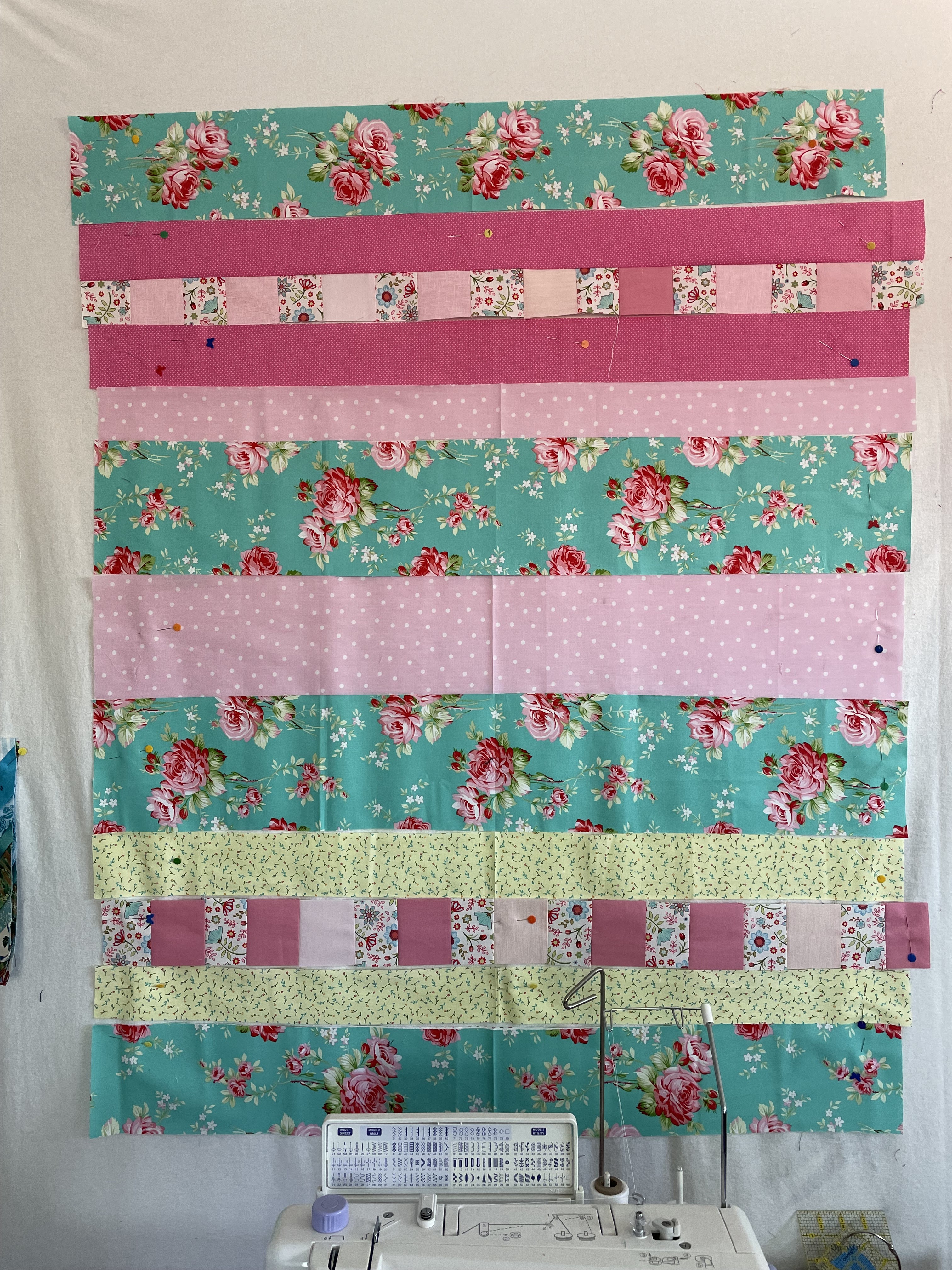
I was going sorting through a pile of pin basted quilt tops, and I ran across this strippy quilt. Because of the construction, it needed only minimal quilting, and so I decided to get it done.

This strippy is made from blocks I foundation pieced on 6" squares of leftover flannel. Because I use a lot of flannel sheets as quilt batting, I end up with odds and ends that can be used for foundations. Once I have enough of these blocks for a quilt, the batting is already there and I only need to add the backing.

The trick is to make the finished blocks bigger than the flannel foundations. When you're piecing, extend the strips beyond the foundations and then trim the finished blocks a half inch bigger than the foundations--these finished at 6.5". That way you can seam them without all that bulk, or in this case, join them with lattice strips.


Here's a picture of the quilt from the back. You can see the cotton extends beyond the flannel foundations, which was from an old sheet.

When you use the lattice construction--which I learned from another blogger whose name I unfortunately don't remember--You cut lattice strips (say 2.5 or 3", but you choose) and iron them in half lengthwise. Then you place four blocks side-by- side, with right sides up in a 4-patch arrangement.


You can see from the photo above, that you align the raw edges of your lattice strip with the raw edges of two blocks, and then sew with a 1/4" seam. Then you iron the lattice strip down and top stitch the folded edge to the other edge of the 4-patch formation, abutting but not overlapping the blocks. Then you repeat the process, joining the 4-patch blocks in the cross-wise direction.

Gee I hope that made sense.

Once you have a bunch of these 4-patch blocks, you join them together in the same way with longer strips.


I had this big piece of pastoral farm print for the back, courtesy of my mother. It's funny, because when Alex was little, I made him a vest from this exact fabric. I quilted the quilt in rows, just to secure the back to the front and middle. All the strips were already attached to the batting. The finished quilt is very warm and snuggly.

I've made other quilts from blocks pieced on foundation flannel before. You can also piece them conventionally, and because the block tops are bigger than the block foundations, when you sew them together, you avoid sewing through too many bulky layers.

I also make a few more of my diamond strippy blocks. I really like how these are coming along.

Monday, October 26, 2009

Laws of Physics

The other day I was making a few more blocks for my spiderweb quilt. This paper pieced pattern uses up some small scraps, so I decided to go through my scrap bin and cut some of the larger pieces into units for a different scrap quilt.

I actually have two scrap bins, but from this one I cut almost all the pieces for the second quilt.

I cut 110 5 x 5" blocks, and even more 5 x 2.5" rectangles. The quilt requires another 20 squares. I think I can scrape together a few more from the drawers full I fabric I have around here.


Since I'm easily distracted, I decided to work on another scrappy UFO. This one uses up skinny strips. You foundation piece them on used dryer sheets. Make sure the sheets have been through the laundry a few times, because otherwise, they're sticky, and they especially stick to your iron. Using dryer sheets for foundation piecing is one of those quilting tips that sounds like a good idea, but it practice, it's not that useful.


But when you get a bunch of these pieced and trim them to 6 x 9" rectangles, I think they look super together.

So I did all this scrap busting, but when I checked the scrap bin, it was still full.


I've discovered a law of physics. Scraps can never be completely used up. At the end of time, it will be them and the cockroaches. We quilters are engaged in an impossible task. The scrap bins, according to the Second Law of Things in Small Pieces, can never be used up. It's impossible. I should give up now.

Sunday, October 18, 2009

Knitted Vest

Yesterday I finished knitting this vest. The pattern for this Woman's Textured Sleeveless Pullover is available free on the web.


I made a few modifications, including knitting the back in plain stockinette, instead of in the fancy stitch pattern. This made it go a little faster, and heck, who notices the back anyway?


The vest was knit from some upcycled yarn I harvested from an 80% lambswool and 20% nylon sweater. I've linked to some good tutorials for reclaiming yarn in the past.


Here's a newly wound batch of upcycled yarn. It's 100% wool tweed and the color is more of a raspberry that the photo shows. The little tags tell me how many yards are in each ball. I figure this out by using a fishing line counter.

But it's not all recycling around here. I bought myself these nice new cowgirl boots. I've been wanting some for awhile, and I found this flat pair that I liked. I have totally lost my capacity to wear high heels, so these are perfect.

Things have been busy at work, but I've had a great quiet weekend. I'm in the lull before the storm: next week I'll have a pile of midterms to grade, and then another the week after that. But for now, I'll put up my feet and knit a bit.

Saturday, October 10, 2009

Garden Harvest


On one of my furlough days I decided to make jam. Michael's neighbors gave him a big box of pears and we made pear butter, pear chutney, and pear-pineapple marmalade, pictured above. Isn't it beautiful?

Then, a few days later, we picked blackberries, about 3 gallons worth, and I made blackberry jam. I also put a couple of bags of blackberries in the freezer for crisps. At the end of all of this, I was exhausted, but looking at all the preserves we put up gave me a feeling of accomplishment. I use an old Sunset Magazine canning book, but I just bought a brand new copy of the Ball canning book, which has great recipes for mustard I want to try. Just owning the Ball canning book makes me feel like a model of self-sufficiency.

This was a good zucchini year in my garden. Last year they did very poorly, but this year I put one plant in a different spot, and it has given me a steady supply of squash. I've made fried zucchini a couple of times. It doesn't use up tons of the stuff like some other recipes, but it's delicious.

Slice the zucchini lengthwise, and dip it in flour to which you've added salt and pepper. Dip that in lightly beaten egg, and then in Japanese style panko breadcrumbs.


Fry until it's crispy on the outside and nice and soft on the inside.


Sprinkle with Parmesan cheese and serve with a little pasta. It's a treat to eat well from things we've grown.

Sunday, October 04, 2009

Harvesting Quilt Fabric from Pillow Cases: Part 3


The top of the pillowcase quilt is done. I really like the way it turned out, and at 71 x 71" it's a pretty good size. I used almost all of the 4-patch blocks I made at the beginning of this project, and two pillowcases were incorporated into the neutral fabric of this quilt.


The colored strips for the blocks and borders came out of the scrap drawer. I thought I had used a lot of strips, but the drawer is, somehow, still pretty full


There is a "where's Waldo?" in this quilt. If you look at the second row in the photo above, you can see that some of the blocks jumped into their own version of order. When I caught this, I decided to leave it as is. It's my little joke to see if anyone notices.

Here are a few more pillowcases waiting for inspiration to transform them into something new. In the meantime, I'm going to be looking through my closet to find a batt and some backing fabric for the finished top.

Saturday, September 26, 2009

Harvesting Quilt Fabric from Pillow Cases: Part 2


Let's pick up where we left off last time. Remember that I had a second pillowcase set aside. From that second pillowcase I cut 4.5" square alternate blocks, and I set both these, and some of the 4-patch blocks, in 4.5 x 2.5 rectangles with 2.5" cornerstones. I wanted to put some "air," or breathing space in all those scraps.

When I made the 4-patches I was trying to coordinate the scraps with the colors in the first pillowcase's fabric, but I pulled a lot of contrasting colors for the outer parts of the blocks to spice it up a bit.


Once I had the blocks made, I cut 2.5" sashing strips and 4.5 inch wide outer borders from the remaining pillow case fabric, and from odds and ends of neutrals that will blend in. A lot of the sashing was cut from some thrifted shirting fabric that someone had cut out with a pattern to make a shirt, but never sewed together. You can see it in the first photo: it has tiny running dogs on it. The neutral border strips make the scrappy blocks appear to float.

I had a lot of 4-patch blocks left over, and these will go in the outer border.


While I was doing all this, it was Bunny's turn to guard the cutting table. She doesn't leave me much space to work. I may have to make my next quilt a miniature. She thinks I should just stop complaining, tidy up the table and put away my piles.

Now all I have to do is sew everything together. I hope to grab a few hours to do this over the next week. Have a wonderful weekend.

Sunday, September 20, 2009

Harvesting Quilt Fabric from Pillow Cases: Part 1

Lately I check the thrift store for pillow cases. The 100% cotton ones, when they're in good condition, make excellent quilting fabric. These were on super-special: I got them for 13 cents each.

I'll buy poly-cotton pillowcases too if I like the print. I have no fear about polyester, and I figure since it's already in the world, I may as well use it and save it from the landfill. Occasionally I find cool vintage prints, but these I bought because I wanted some neutrals to use in a scrap quilt.


I pulled some 2.5" strips from the scrap drawer. I got a lot of these from Debra in a swap.


Once it's washed and ironed, I cut the pillowcase up the long side, taking out the seam. Then I cut it into 2.5" strips. From there, you know the drill. I sewed each neutral strip to a scrappy strip.

The cats love the cutting table because of the sunny window. They're not much help.


The seamed strips were cut into 2.5" units


and these 2-patches are assembled into 4-patches.


I don't worry about creases from the pillowcase fabric. I like to leave little traces of the fact that I'm using recycled materials. When I use shirts, I like to leave in a few pocket or cuff seams.


Each strip of pillow case fabric yielded 6 or 7 4-patch units.


One pillow case yielded over 80 scrappy 4-patches. In part two, I'll dip back into the scrap drawer and use the other pillow case. In the meantime, Wee will guard the blocks.